
Germany records growth in solar self-consumption
Germany records growth in solar self-consumption
Fraunhofer Institute for Solar Energy Systems (Fraunhofer ISE) has developed a new way to quantify PV self-consumption in Germany using national register and grid-operator data, amid a steady rise in onsite use as installations and storage capacity expand.
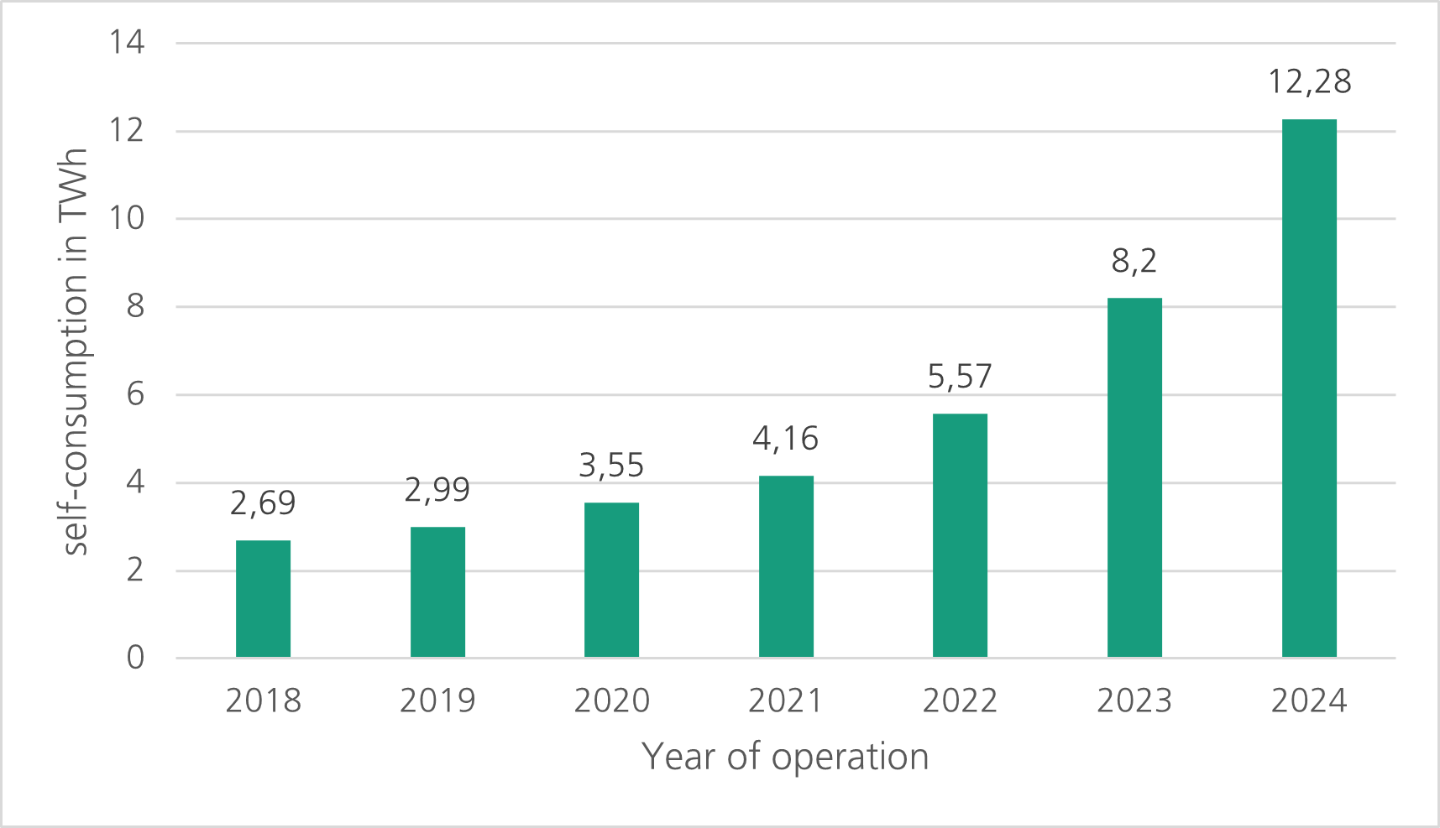
Image: Fraunhofer ISE
Share





From pv magazine Germany
Given high electricity costs in Germany, operators of PV systems see value in consuming generated solar power directly or storing it in battery systems. Fraunhofer ISE has developed a new method to estimate the level of photovoltaic self-consumption.
Self-consumption of solar power is a key incentive for households and businesses to invest in photovoltaic systems in Germany. However, published electricity generation data often makes it unclear how much of the generated output is used on-site.
Fraunhofer ISE has now developed, for the first time, a method to quantify PV self-consumption using data from the Market Master Data Register and the transmission system operators.
Analyses based on this method show a sharp increase in photovoltaic self-consumption. After initially moderate growth, self-consumption reached 3.55 TWh in 2020 and rose to 5.57 TWh in 2022, according to new data released by the Freiburg-based researchers this week. Their calculations indicate that self-consumption from photovoltaic systems in Germany reached 8.20 TWh in 2023.
“In 2024, self-consumption reached 12.28 TWh. With grid feed-in of nearly 60 TWh, self-consumption accounted for 17% of net electricity generation from photovoltaics in 2024,” said Tobias Reuther, data expert for renewable energy generation at Fraunhofer ISE. This represents a significant increase compared with the previous year’s 13%.
Researchers expect the share of solar self-consumption to continue rising – not only due to the ongoing expansion of photovoltaic systems, but also because of growing battery storage capacity and high electricity prices. Self-consumption is particularly attractive for households with heat pumps or electric vehicles. At the same time, it supports grid stability.
“The electricity is produced directly where it is consumed, without ever entering the grid,” said Christoph Kost, head of the Energy System Analysis Department at Fraunhofer ISE.
The new method categorizes the PV system stock according to commissioning date, power class, and system type. By incorporating data on feed-in behavior and installed storage capacity, the researchers estimated self-consumption for a total of 44 distinct system groups.
Fraunhofer ISE’s findings have been included in an analysis by the German Federal Environment Agency (UBA), which also provides extensive data and statistics on the development of photovoltaics in Germany.