
Tunisia accelerates large-scale solar as new players enter market
Tunisia accelerates large-scale solar as new players enter market
The Tunisian government says concession and authorization frameworks are advancing multiple PV projects, while new entrants including SoleCrypt plan additional plants, boosting capacity, self-generation, and panel imports.
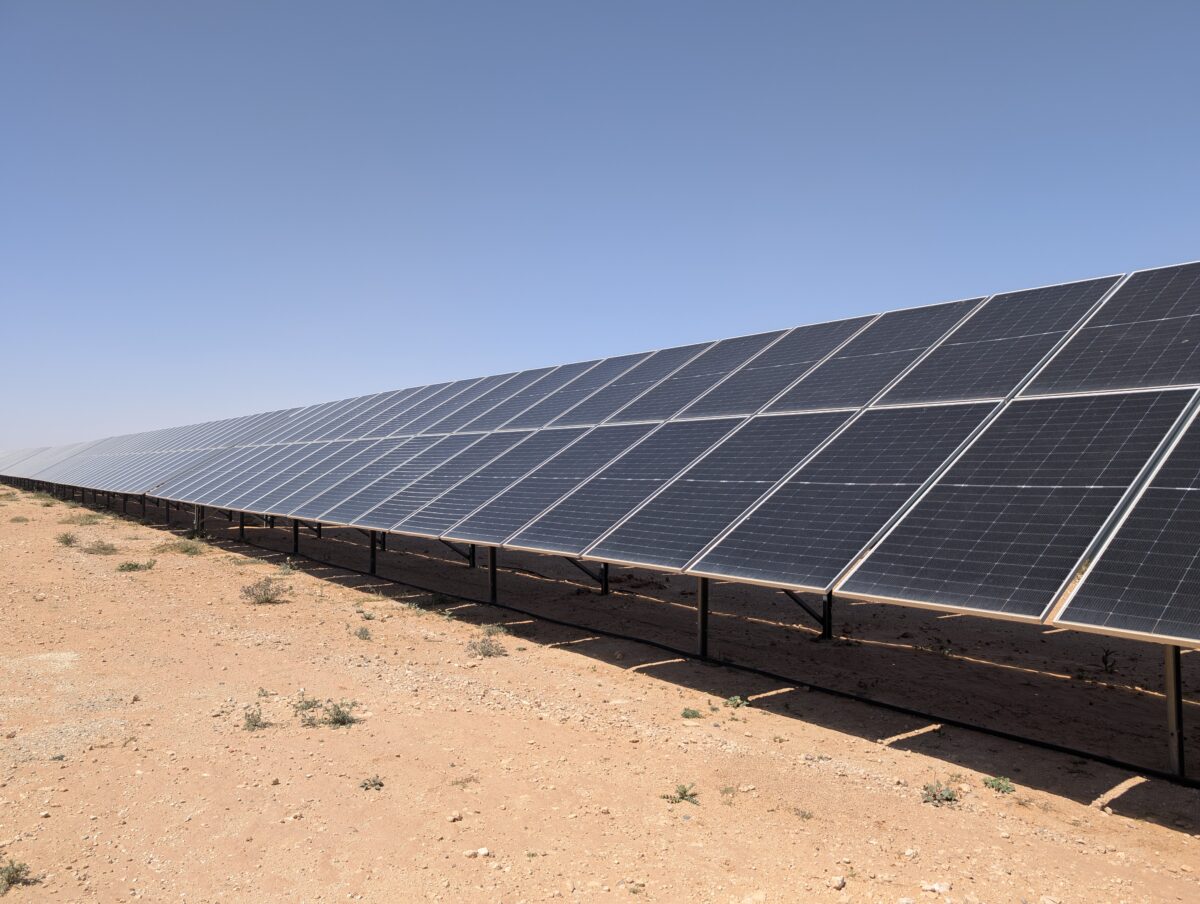
A PV plant deployed in Tunisia
Image: pv magazine
Share





From pv magazine France
After years of delays, Tunisia is accelerating deployment of its large-scale photovoltaic (PV) sector. The Ministry of Industry, Mines, and Energy said construction projects are making tangible progress under both the concession and authorization frameworks, which structure large-scale solar power development by capacity.
Under the concession regime, reserved for projects exceeding 10 MW, the first tender covering 500 MW across five regions has reached key milestones. In Kairouan, the 100 MW plant, financed in 2023, is reportedly 95% complete and could be operational by the end of 2025. The Sidi Bouzid and Tozeur plants, each 50 MW, finalized financing in late 2024 and are nearly 80% complete. The Gafsa project, with a signed agreement in May 2024, is expected online after 2026.
The second concession program, covering 800 MW at privately proposed sites, is also advancing. Three 100 MW plants have been awarded: Qair International will develop El Ksar in Gafsa, Scatec will build Mezzouna in Sidi Bouzid, and Voltalia will construct Menzel Habib in Gabès. Three bids submitted on June 30, 2025, for the second round are now evaluated and awaiting approval.
Another major tender, launched at the end of 2022 for two 300 MW plants, has awarded the first project at El Khobna in Sidi Bouzid, where Qair International SAS will develop a 198 MW plant.
Alongside public programs, new market entrants are emerging. Anglo-Tunisian group SoleCrypt announced plans for a 60 MW PV plant in Tozeur, part of a broader initiative to connect eventually to the Medusa submarine cable, enhancing Tunisia’s energy links with Europe and Africa.
The authorization system, which covers projects under 10 MW, is also active. Fifty-four preliminary agreements totaling 261 MW have been issued, with fifteen projects operational: four 10 MW plants and eleven smaller 1 MW installations. Between October 2024 and June 2025, 186 new agreements were awarded, adding 288 MW, mainly 1–2 MW plants alongside four 10 MW projects.
Self-generation is growing as businesses and households adopt solar. The Ministry estimates nearly 400 MW of low-voltage PV capacity installed, with 70 MW operational, highlighting increasing consumer adoption.
This new capacity complements Tunisian Electricity and Gas Co. (STEG) plants. In Tozeur, two 10 MW plants are fully operational: Tozeur 1 began testing in 2019, partially commissioned in 2021, and at full capacity since April 2022; Tozeur 2, commissioned late 2021, has operated at full capacity since June 2022.
Trade flows reflect this acceleration. Ember reports that Tunisia imported 655 MW of Chinese PV panels between July 2024 and June 2025, ranking sixth among African solar module importers, behind Morocco, Egypt, and Algeria, which each imported more than 850 MW over the same period.