Multi-year field study finds that agrivoltaics can support healthy potato yields
Multi-year field trials conducted in Italy show that agrivoltaic systems can support healthy potato yields without major losses. Strategic shading and dynamic light management during critical growth stages proved key to maintaining productivity.
March 30, 2026 Lior Kahana
A research team led by Italy’s Catholic University of the Sacred Heart has completed a four-year field experiment on potato cultivation under agrivoltaic (APV) systems. The study analyzed how potato yields and characteristics respond to different shading patterns. “The potato crop, despite its global importance, has been relatively underrepresented in agrivoltaic research, with only a handful of studies available,” the team said.
“The novelty of our research lies in combining multi-year field data with a physiological interpretation of crop responses under agrivoltaic conditions,” corresponding author Michele Colauzzi told pv magazine. “Instead of looking at yield reduction only as a function of average shading, we focused on how the timing and distribution of light affect crop development. This allowed us to identify critical growth stages, such as tuber initiation, where light availability plays a key role in determining final yield.”
One surprising finding, according to Colauzzi, was that yield reduction was not proportional to the overall decrease in radiation. “Moderate shading had limited effects, while higher shading levels caused a sharp decline in yield,” he said. “This suggests a ‘tolerance zone,’ beyond which crop performance drops significantly. The timing of shading was more important than the seasonal average, highlighting the role of crop physiology in APV system design.”
The experiments took place at a large commercial APV installation in Borgo Virgilio, Northern Italy. The solar park uses a REM Tec's Agrovoltaico dual-axis tracking system, equipped with 325 W monocrystalline silicon modules with 17% efficiency, with a total installed capacity of 2,147 MW.
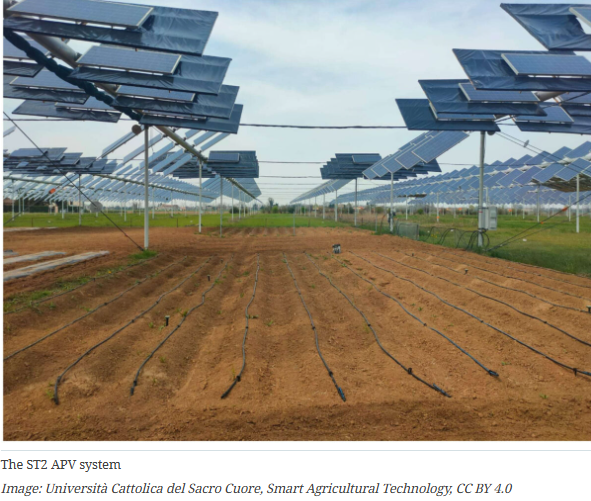
Between 2021 and 2024, four independent field trials tested five shading scenarios. The full light (FL) scenario served as the reference, representing standard potato cultivation without shading. Scenario ST1 corresponded to the unmodified Agrovoltaico tracking system. In scenario ST2‑2021, a high-density shading net measuring 5 m × 12 m was installed horizontally beneath the PV panels, while in ST2‑2022/2023, the team mounted a 3 m × 4 m wooden frame covered with black polyethylene over the panels.
In 2024, an Anti-Tracking (ST1+AT) scenario was tested to reduce shading during the critical tuber initiation phase by rotating the secondary axis 90° counter to the sun. Once tuber initiation was complete, the tracking system resumed normal operation.
Throughout the trials, the researchers monitored weather variables including temperature, rainfall, radiation, humidity, and wind. Ground-level solar radiation and shading patterns were mapped to quantify shade depth across plots. Potato growth was tracked via plant height, leaf area index (LAI), and specific leaf area (SLA). At harvest, marketable yield (t/ha), tuber number per square meter, tuber size distribution, and dry matter content (DMC) were measured.
Mean shade depth for ST1 averaged around 20% annually. ST2 reached 37.5% in 2021 and 42.3% in 2022–2023, while ST1+AT averaged 17% in 2024. Marketable yields reflected these shading levels: 51.5 t/ha under full light in 2021 dropped to 38.9 t/ha under ST1 and 28.0 t/ha under ST2. In 2022, yields declined from 38.0 t/ha (FL) to 29.9 t/ha (ST1) and 24.6 t/ha (ST2). By 2023, yields reached 27.4 t/ha (FL) and 16.1 t/ha (ST2). In 2024, yields were similar under FL (30.3 t/ha) and ST1 (29.9 t/ha), with ST1+AT achieving 32.7 t/ha.
“The standard sun-tracking configuration (ST1), with low seasonal shading (around 13%), caused limited yield penalties (–12% on average), while the higher-shade configuration (ST2) led to reductions exceeding 30%,” the researchers concluded. “AT management during early tuber development partially mitigated yield losses, showing that dynamic light management can help balance agricultural productivity and energy generation in APV systems. Weibull-based modelling of tuber size distribution indicated a consistent shift toward smaller tubers under increasing shade, while tuber dry matter content remained stable.”
The research work was presented in “Potato cultivation in agrivoltaic systems in Northern Italy: a four-year case study on array setup, shading patterns, and yield response,” published in Smart Agricultural Technology. The research team included scientists from agrivoltaics technology company REM Tec.
Recently, researchers from the University of Florence analyzed the impact of an agrivoltaic facility on potato farming through a modeling framework combining PV power production, high-resolution shading mapping, process-based biomass growth and economic analysis. Their findings showed that agrivoltaic systems can reduce potato yield by up to 15% compared to full-light cropping. However, moderate early-season shading was found to delay soil-moisture depletion, extending biomass accumulation and improving water-use efficiency.